The 20 Dollar bill of the United States of America is one of the most common forms of cash used across the world.
Within the world of banknote collecting, called numismatics, people look not only for old issues but also for bills from modern printings, often falling into the category of ‘Small Size’ notes, created since 1928.
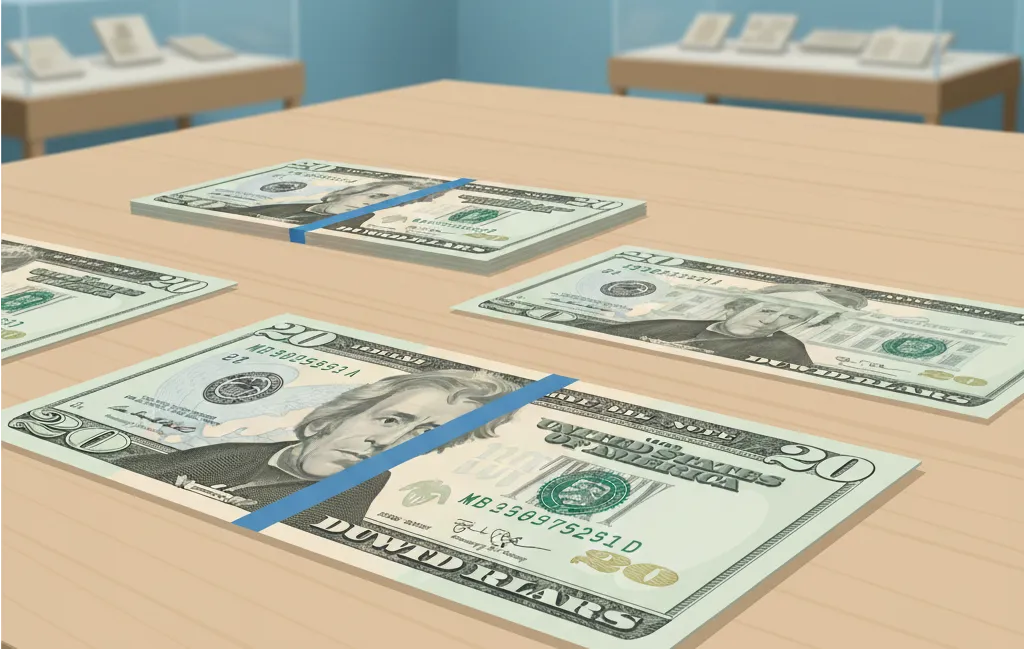
- This paper talks about deciding the investment chance of 20-dollar notes made after 2004.
- This time period started the printing of bills with totally new designs, showing color accents, a stronger security strip, and other modern safety features.
The question of whether it is wise to put money into collecting these modern series needs close thought, their total print runs numbering billions of pieces, greatly lowering the chance of finding truly rare notes.
A collection plan based on getting modern bills can only bring success by focusing on statistically uncommon features, such as unique serial numbers or clear errors made during production.
General Features of Modern Series and Print Volumes
Modern 20-dollar bills are made for the Federal Reserve System of the U.S. Starting with the 2004 series, and including the following series, the notes show an updated look.
Added were background colors, including green, peach, and blue, making them easier to see and harder to copy.
Among the main safety features is a security strip built into the paper, shining green under UV light or a coin worth app, and a watermark showing President Andrew Jackson, whose face is also on the front.
These bills are normal money for buying things, their main job being payment.
The Bureau of Engraving and Printing makes hundreds of millions of them every year.
The number of 20-dollar bills printed for each series often goes over 1 billion pieces.
Such a huge number being made means that a normal 20-dollar bill, even if it has never been used, will usually be worth exactly 20 dollars.
Piling up normal bills hoping for a rise in their value is not a useful way to invest.
The only way to make a profit is to buy a bill for its face value and then sell it to a collector for a price much higher than 20 dollars.
To do this, the note must have a rare feature clearly seen by the collector.
Main Points for Collection Value
The value a modern 20-dollar bill has for collectors is decided not by its print date, but by combining two main points: its condition and its statistical uniqueness.
The note must be in perfect shape, called UNC (Uncirculated) by collectors, meaning it is totally new, having no folds, dirt, spots, watermarks, or damage.
The UNC condition is needed for most modern fantasy-numbered notes to have a high collection price.
Unique serial numbers, or production errors, give a real reason to set a price higher than the face value.
What must the condition be:
- Having no folds at all, even in the middle, makes it different from bills used in ATMs.
- Corners are perfectly sharp, having no roundness or splitting.
- Keeping the first shine and stiffness of the paper.
- Showing no stamps, written marks, or traces of other materials.
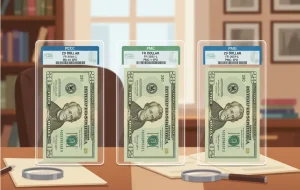
Getting notes judged by professional grading companies, such as PMG (Paper Money Guaranty) or PCGS (Professional Coin Grading Service), is the standard way to set the value and sell them.
The top grade, UNC-70, is given only to notes that are faultless, perfectly centered, and undamaged, which greatly increases their selling price.
Detailed Look at Rare Serial Numbers
The serial number, having eight digits, a letter at the start showing the Federal Reserve Bank, and a letter at the end showing the specific printed sheet, is the main reason for a bill’s rarity.
- Solid Notes: The serial number uses only one number repeated (e.g., 33333333). These are the rarest fantasy numbers, there being only nine possible types (from 11111111 to 99999999) for each series and face value.
- Low Numbers: The number starts with many zeros (e.g., 00000150 or 00000005). The more zeros before the first non-zero number, the higher the value.
- Radar Notes: The serial number reads the same way going forward and backward (e.g., 45677654).
- Super Radar Notes: A radar number also uses only two different numbers (e.g., 81188118).
- Binary Notes: The number uses only two different numbers (e.g., 10110010). The less variety of numbers in the serial number, the higher its possible price.
- Repeater Notes: The serial number repeats a three- or four-number combination (e.g., 14711471). Repeater numbers having equal halves (e.g., 25252525) are particularly valued.
- Ladder Notes: The numbers in the serial number go in order (e.g., 12345678 or 87654321). These numbers are uncommon, but their value is often lower than solid or super-radar numbers.
- Star Notes: Bills where the last letter in the serial number is changed to a star (*). The star shows that this bill was printed to take the place of a damaged bill, this damaged bill being found and removed during the making process.
The total printing of star notes is always much smaller than for normal series, but their value changes greatly based on the specific print run.
You need to check the official BEP website or special coin identifier app free to learn how rare a star note is, and find out the size of the replacement run. Notes coming from runs smaller than 640,000 pieces are thought to be rare.
Error Notes
Errors made during the printing process can raise the price of a note by tens or hundreds of times, being direct proof of a failure in the strict quality control process.
In modern series of 20-dollar bills, because of machines and many checks, the chance of a bill with a big error getting into circulation is minimal.
Still, these errors hold the highest investment interest.
- Cutting Errors: The sheet being moved while cutting, making part of the next bill’s picture or the bill’s margin cut off, and showing part of the neighbor bill on the face of the note.
Big cutting errors, where the edge of the next bill is seen, sell for the most money.
- Printing Errors: One of the printing steps is being skipped. Bills are printed in a few steps: first pass, second pass, third pass. Maybe the third seal is not there or is greatly out of place.
- Offset Errors: The sheet being put in wrongly, the ink being printed on foreign material, that material then being removed, leaving a faded print.
- Fold Errors: The bill is being folded or creased while printing, making no ink reach the folded part. After smoothing the bill, a white line remains.
Expected Value and Investment Dangers
Modern 20-dollar bills, as an object for investment, come with a high level of chance and uncertainty.
Finding a truly rare note in general use is due to luck; it is not the expected result of a planned search.
Trying to search in a planned way by changing large amounts of notes through banks takes much time, and the possible profit may not be worth the effort.
Investment dangers linked to collecting modern series:
- Selling a rare bill can take a long time, needing you to find a special collector willing to pay the high price.
- Setting the exact market price is only possible after professional checking and grading. The price at auctions can be quite different from private selling.
Notes kept for investment must only be stored in special holders or covers made of safe plastic.
Any damage to the bill, even a little fold or fingerprint, can lower its grade from UNC-70 to UNC-65 or less, immediately cutting its collection value by half. Storing them wrongly makes the investment useless.
Conclusion
Modern 20-dollar bills should not be thought of as a sure way to invest money.
Collecting modern series is a game of chance, resting on being watchful and having a lot of luck.
Collectors wanting to gain money should focus their time only on bills showing signs of being statistically unique and being in perfect, collection-ready shape.
Without these unique features, the price of the note will never be more than its face value.
Given the huge number of notes printed, the chance of finding a valued piece is extremely low, but the possible profit from such a chance finding can be quite high.
Investing in this type of collecting makes sense only if you can easily get large amounts of new bills, for example, through your job.